Temple of Edfu
Temple of Edfu
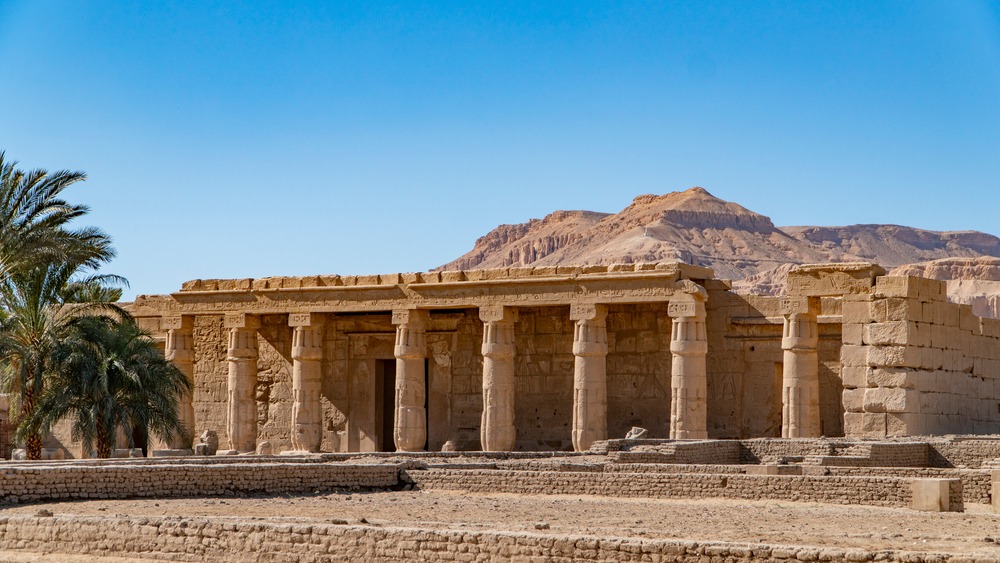
The Temple of Edfu, dedicated to Horus, is the best-preserved Ptolemaic sanctuary in Egypt: a 32-meter pylon, hypostyle halls and intact bas-reliefs.
Located 105 kilometers south of Luxor, the Temple of Edfu is the best-preserved sanctuary in Egypt. Dedicated to the falcon god Horus, it offers a remarkable insight into Ptolemaic religious architecture, with its 137 meters in length, intact bas-reliefs and its 32-meter pylon still standing.
Why visit the Temple of Edfu
The Temple of Horus at Edfu stands out for its exceptional state of preservation. Buried under sand and Nile silt for centuries, it escaped erosion and looting. Visitors find elements rarely preserved elsewhere: a central granite naos, a replica of Horus's sacred barque, and hieroglyphics still legible on virtually all the walls.
The building also illustrates the meeting between the Greek culture of the Ptolemies and pharaonic tradition: commissioned by Hellenistic rulers, it faithfully adopted the architectural codes of New Kingdom temples. It is one of the major stages of a Nile cruise between Luxor and Aswan.
History of the temple
Construction began on August 23, 237 BCE under Ptolemy III, according to foundation inscriptions carved on the walls. Although the project was launched by a dynasty of Greek origin, the architects adopted the pharaonic style to honor Horus according to local traditions. The work lasted nearly 180 years before Ptolemy XII officially inaugurated the monument in 57 BCE.
For several centuries, the temple hosted the Festival of the Glorious Union: each year, the statue of the goddess Hathor left her temple in Dendérah to join Horus at Edfu. The ritual journey down the Nile gave rise to celebrations lasting several days, in which the sovereign participated by bringing offerings to the two reunited deities.
The decline began under Emperor Theodosius I, whose edict banning pagan cults forced the priests to abandon the sanctuary. Deprived of maintenance, the temple was gradually buried under sand and sediment. The top of the pylon was rediscovered in 1798 by a French expedition, and complete excavation was begun in 1860 by Egyptologist Auguste Mariette. Since 2005, a visitor center and guided route have regulated access to the site.
What to see on site
The temple extends over an area of 137 meters by 79 meters, entirely built of sandstone. The typical route follows the axis of the sanctuary, from the entrance pylon to the central naos.
The pylon and great courtyard
The entrance pylon rises to 32 meters. Its walls are decorated with monumental hieroglyphics depicting Ptolemy XII slaughtering his enemies before Horus and Hathor. Two falcon statues wearing the double crown (Upper and Lower Egypt) guard the entrance. Beyond opens a large peristyle courtyard, paved with stone and bordered by columns with floral capitals.
The hypostyle halls
Two successive hypostyle halls lead to the heart of the temple. The first contains, on its walls, the account of the sanctuary's construction. Two side doors provide access to the library and the consecration chamber. The second hypostyle hall leads to the treasury chamber, through which offerings entered, and the Chamber of the Nile, where purification water was stored.
The sanctuary and chapels
At the heart of the temple, the sanctuary houses a granite naos that once contained the golden statue of Horus, as well as a replica of the god's sacred barque. Several subsidiary chapels surround it: the offering hall, the Chapel of Min, the Tomb of Osiris, the Ouabet (New Year Chapel) and the mysterious corridor. A staircase leads to the roof, now closed to the public.
Practical information
- Duration of visit: allow 1 to 2 hours to explore the entire site with a guide.
- Hours: open during the day, generally from morning until late afternoon (check with local authorities before visiting).
- Entrance fee: paid entry, moderate. Combination ticket possible with other sites in the valley.
- Guide: recommended to understand the bas-reliefs and ritual organization of the halls.
- Equipment: water, hat, closed-toe shoes. The site is largely open-air.
When to visit
The high tourist season in Egypt runs from October to April, with comfortable temperatures for visiting archaeological sites. This is also when most Nile cruise boats operate. From May to September, temperatures frequently exceed 40°C in the Nile valley: visits are still possible early in the morning, but crowds thin out. To avoid tour groups, favor early morning or late afternoon visits.
How to get to the Temple of Edfu
By Nile cruise
The majority of visitors arrive at Edfu as part of a cruise between Luxor and Aswan. The boat docks at Edfu port; a taxi or horse-drawn carriage allows you to reach the temple, located at the western edge of the city.
By train
Edfu station is served from Luxor and Aswan by the Nile valley railway line. Allow approximately 1 to 2 hours of travel depending on the origin. A taxi then reaches the site in a few minutes.
By car
From Luxor, the road runs due south along the Nile. This is the option that allows you to combine Edfu with the Temple of Khnum at Esna and the Temple of Kom Ombo in the same day.
Nearby
- Edfu: the small town surrounding the sanctuary, starting point for your visit.
- Temple of Kom Ombo: typical next stop on a cruise, dedicated to Sobek and Haroëris.
- The temples of Aswan: group of sanctuaries downstream on the Nile cruise.
- Temples of Abu Simbel: excursion from Aswan to the colossi of Ramesses II.
Frequently asked questions
Frequently asked questions
The temple is dedicated to Horus, the falcon god of Egyptian mythology. It is the largest sanctuary dedicated to him and one of the best-preserved in the country.
After the prohibition of pagan cults under Theodosius I, the sanctuary was abandoned and then buried under sand and Nile silt. This burial protected the walls and bas-reliefs until excavation began by Auguste Mariette in 1860.
Allow approximately 1 to 2 hours to explore the entire temple, from the pylon to the central sanctuary, taking time to observe the hieroglyphics and subsidiary chapels.
Yes. Edfu is traditionally visited in the same circuit as Esna (Temple of Khnum) and Kom Ombo, either by Nile cruise or by car from Luxor.
The most comfortable season runs from October to April, with moderate temperatures and good availability of Nile cruises.
Plan your trip
The Temple of Edfu fits naturally into a Nile cruise itinerary between Luxor and Aswan. To build a customized trip that includes this stage, consult our suggestions for trips to Egypt.
Interested in this visit?
We can include it in your personalised itinerary.